5/31/2009

Art and text - writing the exegesis

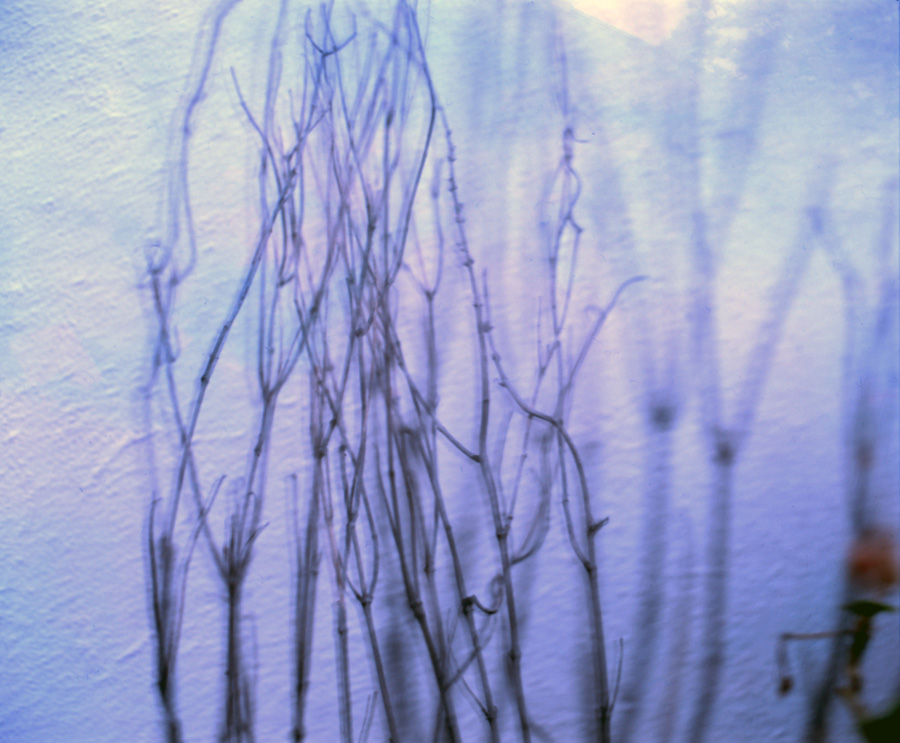
I am coming to the point of my MFA where I am having to formulate the plan for the written exegesis. I do have a strong grasp on my visual elements, my photographs and lightscapes. As a narrative of elements I can read them well. They feel strong, they convey and speak how I want them to. How then - Do I adequately translate or describe these images via the use of text. The actual written element to my MFA has been giving me a certain amount of anxiety. I get terrified sitting and looking at the blank white void of a piece of paper or a word processing workbook. I am frustrated by the 1.5 spaced linework and the deep theoretical arrangement of my ideas. In my images, how I feel and what I want to say comes very naturally. However, the written part stand so far apart from my aesthetic. The text is bland, long, it meanders through syntaxes and discourses that are heavy and cold.

I have been thinking a lot about how to challenge my written element, how to approach it so that it complements and extends my visual research, not just stands beside it as a static and confusing essay. Speaking with my supervisor, I explained my hesitation, my fear that the images and the text would end up working against each other, not with each other.

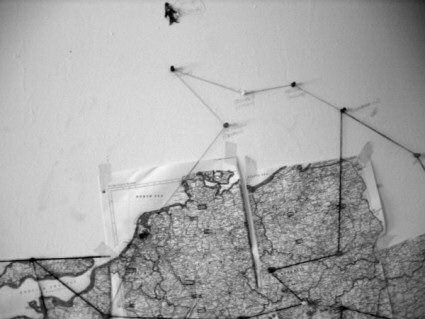
She suggested that perhaps I wanted to approach my exegesis as an artists book. A visual/textual (intertextual) combination, that would aim to sew my ideas together, offer a mapping or topological tool to formulate a discussion that works with my visual elements. I think, in my head, I had this surge of relief. This was the permission I was after. It seems strange that you would need permission to explore your own practice, but sometimes the practicalities and expectation of an academic environment weight heavily. Marks, scholarships, applications, deadlines all scream for you to keep working with the establishment. But now I had someone saying that this course, indeed my research area almost craved an exploration using intertextual elements, maybe even a narrative story, meandering the colour and spaces of my images, throwing out questions only to pick them up on a later page, where ideas folded out into big maps, where there could be conversations and notes and diaries, a real examination of the research process, a real confrontation with the idea of writing and the idea of art (are they so different).

So now I am working on how to pull it all together. The visual (I can see) the text (I can hear) the meshing of synapses.

A map is, after all, just another kind of picture.


so.

What do you want to say?
How can many elements help to tell the same story?
Does this show a sense of immediacy or urgency?
Is it cohesive? Can it be cohesive?
Is it accessible, can it be read and understood?
How can my aesthetics be explored through text?
What is the language I want to use?
How do I read art, how do I read text?
how can writing then become an object?

Am I an interdisciplinary professional? Have I just realised how everything connects? How do I allow the text to contribute to my visual work? Is it an aside, or is it essential?


Wordle: art and text exegesis

Labels: , , ,

2/22/2009


Why a landscape


The landscapes of my work form the passing impressions so similar to the figurative backgrounds that Zummer alludes to in describing ‘architectural projections’ [1]. They (both the natural landscapes and the digital architectural plains of the city) “operate in the marginal space of peripheral vision, as something almost already past, its import lying in having been, in enframing rather than engaging.” [2]

The buildings provide the necessary frame [3] for our compulsion to reside in image-spaces. Within a city, unconsciously, the four sides of a screen/photograph are perpetuated; in the reflections in windows, in signs, in advertising in scrolling textual forms. In the same sense, the trees and flowers and leaves and ground provide a psychological frame, a reflective agent so familiar to an individual, so utterly everyday as to not even be registered as individual elements.

In a way both the physical grounding in the city’s image-space and the memory-spurned movement into the languid fresh plant matter of the photograph speak of the idea of this has been [4] waiting, operating in a time distinct to our own, but nevertheless waiting, "always ready to be there" [5].

The change of the impersonal space (I do not see it in my own terms) into the personal space (so easily knowable, show me how) is observed through time; a slowing of pace and the still image can be consumed. As the pace slows, and distance is reduced, I am at the point of pause/delay, the flash of an image to the side; a reflexive marking engages my body. I see now through the spaces of the trees, the spot of sunlight reflected back to me, the potential space for my memories to reside. I become taken with the idea of drowning in an image, in my “quest for hallucination” [6].


[1] Zummer uses Times Square as an example of this formation of media, with its wrap around digital signage, flashing advertising walls and neon signs.
[2] Thomas Zummer; Variables: Notations on Stability, Permeability and Plurality in Media Artifacts, in Saving The Image Art After Film, ed. Tanya Leighton and Pavel Bucher, Centre for Contemporary Arts Glasgow, 2003.
[3] The frame can be the borders of a physical space, the rectangular containment of a cinema screen, the frame of a photograph, the exact physical dimensions of a picture, and of course a discourse frame giving the permissions, standards and context to an idea existing in the world.
[4] Roland Barthes, and discussed in the Bruise of Time chapter.
[5] Zummer 239
[6] Barthes, the cinema as consent of illusion, the photograph as quest for hallucination.

Labels: , , ,

12/09/2008

NOTES / IDEAS / PHRASES / IMAGES

"Also if we are moved by a photograph it is because it is close to death" - Christian Boltanski

"Is the evolution of time (temporal dimension) denied to the photographic still any longer?" - David Green Marking Time

"This has been" - Roland Barthes (what does this become?)


The Becoming image:
Hesitating
Held back
Consumed before emerging...


The architecture of inter-activity (audio-visual structure), what to view and when? Narrative reorganisation. Who is a viewer, who is a user? Nothing happens without the user's initiation. Is this predetermined?

Photo - having been there
Film - being there
Becoming there
Blooming.


The photo recedes (it has already been there), the film proceeds (slow), caught between linear stretch back and forward in time. The delay. Delay of what? Time, a moment, an action, a thought, a realisation, an ending, a resolution?

The external present tense THIS (indexical). No tense - just factuality and something.

New temporalities - an image viewed on a screen as opposed to an image object (refreshing the screen).

Real-time (unreal-time?), the internet's lure of connectivity and availability, a "denial of mediation" - MaryAnn Doane - Real Time.

The visibility of time in visible time - David Green.

"Of the countless movements of switching, inserting, pressing and the like, the 'snapping' of the photographer has had the greatest consequences." - Walter Benjamin, "Subject grows into picture".

Power in the unknowable - no speed, delivery of information (I can feel it moving). That is the pause and delay, longer exposure, focus not fixed, belonging to a narrative that is never revealed. What are the implications? "A small concussion" - Martin Arnold sp sp spaces of inscription.


WORKS:


Susan Hiller - Whispering Voices. In ‘Witness’, whispering voices can be heard coming out of hundreds of suspended speakers.


Hiroshi Sugimoto - Theatres. Long-time exposures run the length of the feature, the white glow of the screen is an entire narrative capture in stillness.


passage à l'acte - Martin Arnold. Four people at the breakfast table, an American family, locked in the beat of the cutting table. The short, pulsating sequence at the family table shows, in its original state, a classic, deceptive harmony. Arnold deconstructs this scenario of normality by destroying its original continuity. It catches on the tinny sounds and bizarre body movements of the subjects, which, in reaction, become snagged on the continuity. The message, which lies deep under the surface of the family idyll, suppressed or lost, is exposed - that message is war.
"The first shock, the first flight, the fear at the beginning of the film: The son jumps up from the table and throws open the door, which sticks in an Arnoldian loop of hard, hammering rhythm. He is compelled to return to the table by a mechanically repeated paternal order, 'Sit down.' And at the end, when the two children spring up, finally released from their bondage, Arnold is again caught at the door; at the infernally hammering door, as if it were completely senseless to try to leave here - this location of childhood and two-faced cinema." - Stefan Grissemann.


Lori Hersberger - Sunset.


Seven Minutes before - Melik Ohanian.


Michael Snow - Breakfast (Table Top Dolly).

Labels: , , , ,

5/29/2008

Before Focus is Fixed

The purpose of this MFA study is to develop a contemporary understanding of and visual response to the photographic in relation to the moment, pause and delay. The study takes the knowledge expressed in historical and contemporary readings of photographic and cinematic time and seeks to readdress this knowledge in relation to a modern technological framework. My visual practice centres on a “point of convergence” between separate modes of creating and theoretically indexing the photographic moment. This revaluation of ‘the moment’ and the slippage between historical distinctions between cinematic and photographic time is manifested in the subject, object and content of the work produced.

A central concern of my visual investigation is with the contemporary blurring of the distinction between the photographic object’s inherent stillness, and the constant narrative sequence of cinema. New technologies such as the internet, DVD, home cinema, digital video and photography are staring to collapse the distinction between photographic stasis and cinematic fluidity. The ability for a person to pause, rewind, re-watch, stop and manipulate the narrative sequence of a film has disturbed the flow of narrative; an expectation of narrative and conclusion has now given way to a pause or delay, a glitch in the flow of cinematic time(1).

This delay has effectively exposed the separate still images in cinema and disturbed the continuity of narrative, resulting in a state, where, as Mulvey writes, a ‘film’s original moment of registration can suddenly burst through its narrative time … the now-ness of story time gives way to the then-ness of the time when the movie was made, and its images take on social, cultural or historical significance, reaching out into its surrounding world’(2). This now and then dichotomy is also explored by Barthes when describing the function of the punctum(3) in reading a photograph.

Effectively as cinema is slowed and paused, the resultant stills take on a photographic reading, and combined with their cinematic origins produce a new sense of time, where expectation is both muted and delayed, and a new relationship containing the real and unreal, still and moving and then and now is created. The narrative is now controlled by the viewer, who can slow time at will. The viewer divests new readings into the resultant still images, paused in an effective slumber, repetitive short moments on repeat, fixed upon, re-watched and re-contextualised. The cinematic still provides the viewer with the opportunity to categorise, memorise and reorder cinematic images far from the specific temporal confines of time past/future. The effect is very immediate.

My work, though use of still photography, narrative film sequence and time capture stills, seeks to examine this pause or break or ‘irrational interval’ before focus is fixed. Historical modes of reading the photograph will be taken into consideration and reinterpreted in relation to contemporary filmic and photographic modes of production and consumption. My research attempts to make sense of this delay and examine the power the delay has on the way images are produced. I will discuss how our contemporary relationship to the image is changing the way we interact with ideas of the moment and representation. My research aims to discover if the disruption is limiting or liberating, and, that by way of delay, if cinema becomes reliant on the photographic index as narrative shifts between movement and pause. What lonely spectres emerge from the repetitive pause? How do we read “movement and flow” when we have the power to delay the eventual ending? What does the photographic image(4) mean to us now when we have the power to delay time? Does this change our expectation of the moment contained in an image? What is revealed?

In this vision conscious contemporary world, there is a deep impulse to seek meaning and truth (recognition) from a photographic (still) image. The artists I will discuss in relation to my own practice explore issues of time, delay, blur, mnemonic register and repetition in the image, through process, object and output. They cover a historical and contemporary field of “vision” and seek to impart a sense of how spectatorship of the (still) image is informed by both photographic histories and ideas of the cinematic narrative (slowed). Particular attention will be paid to Douglas Gordon, Hioroshi Sugimoto, Martin Arnold and Peter Tscherkassky with theoretical reinterpretation of the works of Laura Mulvey, Roland Barthes, Paul Virilio and Jonathan Crary.

I aim to produce a lyrical essay reflecting on my own practice, and questions that arise from my own image creation. The function of the essay will be to strengthen my question asking capacity and situate my work in the now. A basic proposed structure is below, but of course is driven by the evolution of the artwork.


1. Maria Walsh, in ‘Against Fetishism: The Moving Quiescence of Life 24 Frames a Second’ refers to a Cinema of Moments, which seems to accurately describe the condition of the cinematic flow made still, the delay and rupture of filmic sequence. Further it could be said that a stilled image could now be read as belonging to the cinema of moments, wether captured from movement out of a cinematic sequence, or wether a standalone photographic image not related to an original narrative structure.
2. Laura Mulvey, Death 24x a Second: Stillness and the Moving Image pg 30-31.
3. In my research Barthes’ Punctum refers not to the ‘detail’ of the image that draws you in, but of time, the duration of the image, the “that has been” - a call back to the true moment of representation.
4. Terms of distinction between the photographic and film still are still hazy, though I expect a more concrete term will emerge though research and practice. Perhaps just ‘the still’ will suffice prefixed as appropriate with cinematic or photographic. Combined they are as previously mentioned the Cinema of Moments.


Before Focus is Fixed - Chapter Outlines

The Bruise of Time
A re-reading of photographic and cinematic time – what is a “still”, what is contained in an image, what is the image’s duration? How do we read still images now – in light of new technologies and impulsive image viewing practices?

Coming Up for Air
Repetition and delay in contemporary visual practice.
If the distraction and flow is taken from cinema in the form of a delay, a pause, how does this affect our reflection, and, is the reflection and pensive and sometimes obsessive action of viewing the pause, consuming the delay – different from the photographic still? And if the delayed moment constant, repeated, duration is put on hold, then what does that moment become – is it contained, or does it break free from its stream of messaging?

I have nothing left to give; but you always want more
New modes of spectatorship.
What is discovered by the pause? How does this change the way we read a photographic still? Is the still now imbued with the power of the cinematic contained?

The Bloom of Recognition
Towards new interpretation on indexation and mnemonics in the cinema of stills.

But what does it mean for me now?
Afterthoughts of an image.

Labels: , ,

5/12/2008

a visual reminder

4/18/2008

The duration of time - After Bergson, Barthes and Deluze

“…looking at a photograph, I inevitably include in my scrutiny the thought of that instant, however brief, in which a real thing happened to be motionless in front of the eye. I project the present photograph’s immobility upon the past shot, and it is this arrest which constitutes the pose” - Roland Barthes

Expectation of movement

Repetition without difference (The Photograph) not without difference from the “original” object, but without difference from itself a moment ago -Geoffrey Rhodes

Repetition with difference (Cinema) Barthes considers the “distraction” of cinema, the constant flow of images.


The photo has no “durée” (Henri Bergson) but forces the viewer to impart their own “durée” (subjectivity), their own perception. Cinema occupies the mind, does not allow for contemplation, images are forced to be viewed in a sequence, unfolding a narrative.

Relationship to the photo image (per Deluze) is that we view our changing present and an unchanging point in the past.

The spectator is actually stringing together pieces of duration into a whole, a present, a virtual. This launches the viewer into the film: lured in by his own perception, the viewer becomes a denizen of the cinemas durée, forgetting his own.

The photograph forces contemplation with the self (sublime, but an ideal of wanting to submit to the static form of the image (this causes a tension) there is no resolve.

Barthes “Photographs are signs which don’t take, which turn, as milk does. Whatever grants to vision and whatever its manner, a photograph is always invisible: it is not it that we see”

Mnemonics (transference) subjectively and physically, a connection through the impress of light and the impress of subjective thought, the duration of time for the bloom of a burn or light and the creation of a memory, the act of viewing, the bloom of the image awakened in their viewers mind.

Light -> duration -> image creation-> Image viewing -> memory formation -> recognition - > mnemonic referencing

Light -> Impression -> Recognition

Labels: , , ,

12/03/2007

A pictorial reflection on Henri Bergson Matter and Memory


Matter thus resolves itself into numberless vibrations, all linked together in uninterrupted continuity, all bound up with each other, and travelling in every direction like shivers through an immense body.- Henri Bergson Matter and Memory

Labels: , , ,

reflection on: A History of Colours, Manilo Brusatin


This is beautiful:

Sounds reveal a passage of time, an intensity, a timbre; colours a darkness, a clarity, a tone. Timbres and tones may possibly bear a resemblance to each other, but beyond these, sounds seem to fly away (reverberate) into the dimension of space, which contains them, whereas colours move through the dimension of time, which keeps or consumes them. We are pushed toward the colours of our memories as towards the resonances of places we have known. - A History of Colours, Manilo Brusatin


This is kind of exactly what my entire practice is about. Colour, Light, Memory, and the psychology of these tones' physicality, the knowledge of their appearance and their use as mnemonic devices.

Its like pathology, and photography captures it so well. The drama of space that contains them, propels them, and the bodies that feel their pulse and perceive them. Its so quiet, so slow, so elongated, the feeling of describing them bloom of light/colour in the mind or on the body of a person. Like a memory or scar. A secret.

Labels: , , , , ,

9/28/2007

list of references for the lyrical

Bartusiak, Marcia, 2000, Einstein’s Unfinished Symphony. Listening to the sounds of Space –Time. Joseph Henry Press, Washington, D.C.

Bergson, Henri, trans. Paul, N. M and Palmer, W.S, 1991, Matter and Memory, Zone Books, New York.

Brusatin, Manlio, trans. Hopcke, Robert H and Schwartz, Paul, 1991, A History of Colors, Shambhala Publications, Boston, Massachusetts.

Cadava, Eduardo, 1997, Words of Light, Princeton University Press, Princeton, New Jersey.

Cage, John, 1939, Silence, Lectures and Writings, Marion Boyars Redwood Books, Trowbridge, England.

Cassiman, Bart & Ramael, Greet & Vande Veire, Frank, eds., 1993, The Sublime Void (On the memory of the Imagination), Koninklijk Museum voor Schone Kunsten, Anterwp.

Crary, Johnathon, 1990, Techniques of the Observer. On Vision and Modernity in the Nineteenth Century, October Books MIT Press, Cambridge Massachusetts, London England.

Deleuze, Gilles, 1986, Cinema 1:The Movement Image, University of Minnesota Press, Minneapolis, USA.

Derrida, Jacques, trans. Pascale-Anne Brault and Michael Naas. 1993, Memoirs of the Blind. The Self-Portrait and Other Ruins, The University of Chicargo press, Chicargo and London.

Foster, Hal, 1993, Compulsive Beauty, October Books MIT Press, Cambridge Massachusetts, London England.
Herbert, Lynn M. & Ottmann, Klaus & Schjeldahl, Peter, (essays by), 2001, The Inward Eye. Transcendence in Contemporary Art, Exhibition catalogue, Contemporary Arts Museum, Houston.

Kaprow, Allan, ed. Jeff Kelly, 1993, Essays on the Blurring of Art and Life, University of California Press, Berkeley, Los Angeles and London.

Kant, Immanual, trans. Goldthwait, John T, 1960, Observations on the Feeling of the Beautiful and Sublime, University of California Press, Berkley and Los Angeles.

Lyotard, Jean–Francois, trans. Rottenberg, Elizabeth, 1994, Lessons on the Analytic of the Sublime, Stanford University Press, Stanford, California.

Merleau-Ponty, Maurice, ed. Claude Lefort, trans. Alphonso Lingis, 1968, The Visible and the Invisible, Northwestern University Press, Evanston, IL, USA.

Parry, Eugenia, 1997, Adam Fuss, Arena Editions, New Mexico.

Rinder, Lawerence ed., 1999, Search light: Consciousness at the Millenium, Thames & Hudson, London.

Stoichita, Victor I., 1997, trans. Glasheen, Anne-Marie, A Short History of the Shadow, Reaktion Books Ltd, London with the contribution of the Council of the University of Fribourg, Switzerland

Labels: , ,

6/22/2007


Apparitions at twilight

Night storms, darkness, hidden existence. An electric clap and the hidden is made visible. A drama of space between the negative and the positive, light and dark. Knowable forms give way to blooming apparitions. We see a change, a shift, an uncomfortable awakening. For a moment I must recognise: what I hear, see, and feel; this forms what I know. These are the senses that make me, and my knowledge of this space. Then, seen slightly, as if in a dream state, a flash, the sky opens, a temporary emergence of the hidden, an illumination in the half-light. In a quickening of optical impulses I see the leaves, the tree. Then it is gone. The photograph slows the apparition. An eternal moment.


“In either case, what is seen fills the field of vision, but the field of vision is never taken as all there is to see.”- Marilyn Strathern After Nature


I am thinking about here, to borrow a term from Walter Benjamin, the body as darkroom. The body itself as a house of images. Light impressions pressed into the skin, literally burnt on our bodies. A participation in an organic process. The water creates rivulets on her back, her hair is like a foliage creeping over, moving towards the light. Outside, in the darkness, light floods through branches. There is a slow awakening, a blooming as the trees take their shape, other organic apparitions. Once before the trees were hidden from themselves, or hidden from my own self. I am seared through with light. Becoming an apparition.


I am experimenting with photographing as I walk, as I interact. The photographic act is integral, the camera is my third eye, it uncovers what I can not see alone. There are twilight forces; storms, the sea, wind, lights, and also, apparitions of the day. Full sunlight, shimmering iridescence, blindness by light. I am reading Words of Light I am reading Fear of Freedom, I am reading Invisible Cities and Warped Space. I recognise that my images are informed by the junction, or in some ways, collision of the natural organic world, and the constructed human world. In images such as the above I want to have an absence of the perceptible (the street) but recognise that the natural is still bound to the constructed world it pushes against. The hidden world exists in the one I live within. It is not a metaphoric or idealised natural landscape or the country-side where nature exists as intended. It does exist both outside of me and inside of me. It is my physiology. It is nature slipping between and beneath buildings. It is oil slick. It is the water parting over concrete, it is a body and a skin, existing on the edge between sight and touch, measured in the time a word is spoken, a memory recalled, a flash of lightning, a sunburn to form.


Transformations of the landscape affect the definition of the subject regarding them. I am interested in the meteorological nature of my work. A leaf falls against a gutter, clinging for a moment before being swept along.


I think of the work of Bill Viola - Departing Angel and The Reflective Pool. My own physiology dwells in contrast to the immediate constant flow of water, and its ebbs and cycles. I am still, and a participant only in stages. I wonder about wandering in a fog, and how different things would seem there. Known things, a road, a sign, a path, a puddle. I think about technology, how I could know all things, maybe. I could know everything, but I know nothing. I comprehend cyberspace but barely know my own geography. I am a stranger in the dark. The tree resembles a human limb, my limb, my phantom limb.


My Ghost

Labels: , , , ,

3/01/2007

Images


The images untitled8-2006 and untitled9-2006 are part of an untitled projection series that was shown on built surfaces. This series explores the dialogue between internal and external emotional states and physical spaces. The hidden interior of human thought is contrasted with the x-ray image of a breast, symbolising the ‘bloom’ as referred to in another image. The internal secret bloom is then projected externally, impersonally, for all to see. The two images speak of both physical and emotional darkness.

Labels: , ,

Discussion Points

How does one identify an anxious state, an anxious place or an anxious act? How can a state of anxiety be created or represented through an artwork? What are the triggers of an anxious state? Do we hide from these triggers, or do we cultivate them through the way we act and subsequently, through the way we make art?

--

I want to:

examine how the viewer's own subtle self-references of memory, guilt and culpability condition them to be influenced and affected by certain imagery, be it of a person or a specific space.

explore how anxiety manifests (influenced by internal and external sources) and explore the performance of these manifestation or apparitions in my work, through way of gesture, gaze, construction and intent.

elucidate ideas of duration, permission, exposure, tension, intimacy and claustrophobia.

focus on the psychological manifestations of a space and our preconceived notions of how a space must occur and behave (and in turn, us within such a space).


Currently:

I have been thinking a lot about images of the landscape, particularly urban landscapes, reconfigured as menacing, collapsing and containing, or in opposite, landscapes that are completely autonomous and impersonal.

I am interested in explorations using the gestures and physical movements of the human body, and their source from and effect on an anxious state, and how one can explore these movements within the photograph.


Some Ideas of why?

These concepts are relevant in view of the hyper-real and super-connected channels of communication existing in contemporary culture, such as language barrier breakdown, mutable geography, the Internet, and the slow corrosion (or superseding) of “normal” cultural practices in favour of an ideal or acceptable way of acting.

Labels: ,